
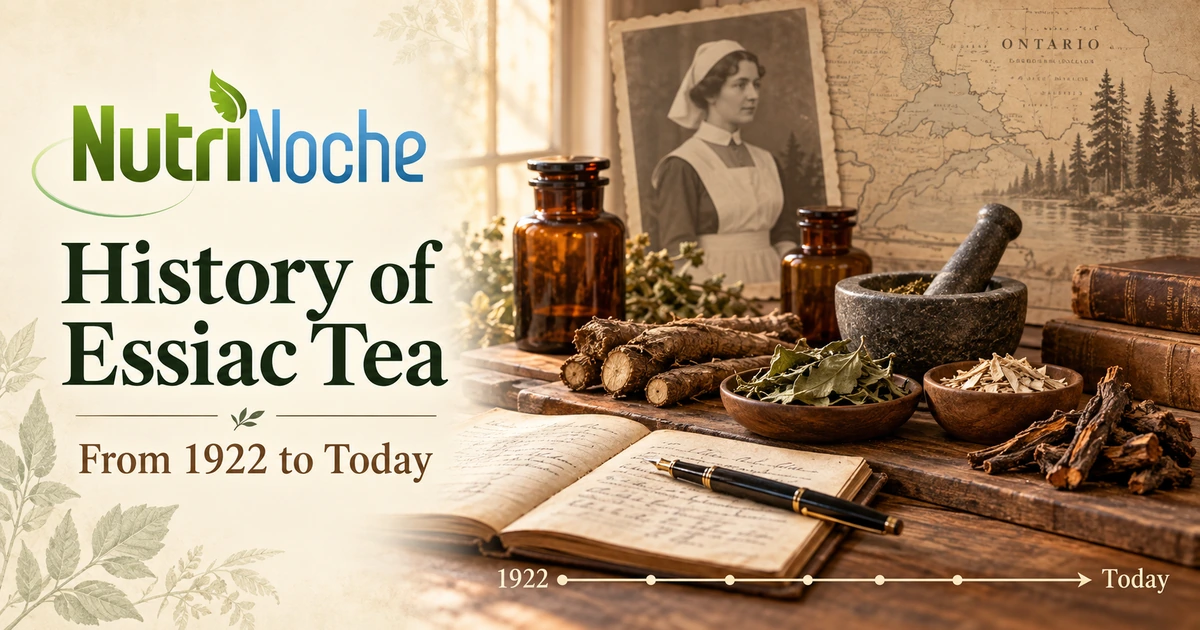
Who Was Rene Caisse?
Rene Caisse (1888–1978) was a Canadian nurse whose name became permanently linked to one of the most enduring herbal traditions of the 20th century. Born in Bracebridge, Ontario, Caisse trained as a nurse and spent much of her early career in hospitals in Ontario. She was not a doctor or a botanist — she was a nurse who, according to the accounts she gave throughout her life, encountered an herbal formula that would occupy her attention for more than fifty years.
Caisse is remembered as a quiet, determined figure who repeatedly refused to sell her formula to commercial interests. She insisted on controlling the preparation herself and, for decades, offered the tea at her own clinic rather than licensing it to manufacturers. This insistence on personal stewardship — combined with the mysterious origins of the formula — turned Caisse into a folk figure in Canadian herbal history.
“I will not sell it to anyone. I want to give it to people who need it. I don't want it to become a money-making proposition.”
The story of Essiac tea is inseparable from the story of Rene Caisse. Understanding her life helps explain why the formula was never patented, why it remained outside mainstream medicine, and why so many variations of it exist today.
The Origins of the Formula
According to the account Caisse told repeatedly, her introduction to the herbal blend began in 1922 when an elderly patient in a hospital where she was working mentioned a traditional herbal preparation. The woman, often identified in historical retellings as a prospector's wife, described a recipe she said she had received years earlier from an Ojibwa (also spelled Ojibway) herbalist.
Caisse reportedly wrote down the formula and began studying it. At the time, herbal preparations passed through oral tradition and local practice were common across rural Canada. The idea that a nurse in a small Ontario town might encounter a botanical blend with indigenous roots was not unusual for the era. What set Caisse apart was her decision to keep working with the formula for the rest of her life.
A Name Spelled Backward
The name 'Essiac' is simply 'Caisse' spelled backward. Caisse chose this wordplay as the name for her preparation, a gesture that tied the formula to her own identity. It also meant that the tea would always carry a reminder of the woman who spent her life promoting it. Nearly every Essiac tea sold today — including NutriNoche's ready-to-drink version — traces its lineage back to that naming decision.
Rene Caisse's Timeline at a Glance
Caisse's relationship with the formula spanned more than five decades. The timeline below highlights the key moments that shaped how Essiac tea developed and why it still exists today.
- 1922Caisse first learns of the herbal formula
While working as a nurse, Caisse hears about an herbal blend from a patient familiar with Ojibwa herbal traditions. She writes down the formula and begins studying it.
- 1924–1926Early experiments with the blend
Caisse begins preparing the tea and, according to her accounts, shares it with people she knew. She refines the proportions of the herbs over several years.
- 1934The Bracebridge Clinic opens
Caisse opens a clinic in Bracebridge, Ontario, where she offers the tea to visitors. The clinic would operate, with some interruptions, for more than four decades.
- 1937Attention from Canadian health authorities
Caisse's work draws scrutiny from Canadian medical and government authorities. She is permitted to continue under specific conditions but never receives formal medical approval.
- 1959Collaboration with Dr. Charles Brusch
Caisse works with Dr. Charles Brusch of Massachusetts, who reportedly studies the formula alongside her. The collaboration raises the profile of the tea in the United States.
- 1976The Bracebridge Clinic closes
After more than 40 years, Caisse closes her clinic as her health declines. She continues to prepare the formula privately.
- 1978Rene Caisse passes away
Caisse dies at age 90 in Bracebridge, Ontario. She never sold the formula and never received the formal recognition she spent decades seeking.
- 1978 onwardThe formula continues without her
Interest in Essiac tea endures. Various manufacturers begin producing their own versions, leading to the range of formats — loose herbs, tea bags, capsules, and ready-to-drink liquids — available today.
The Bracebridge Clinic Years
The Bracebridge Clinic, opened in 1934 in Caisse's home town, became the center of her life's work. Visitors traveled to the small Ontario town seeking the herbal tea, and Caisse prepared the formula herself, overseeing every batch. The clinic was not a hospital in the conventional sense — it was a modest operation where Caisse offered the tea according to her own methods and beliefs about preparation.
Caisse's insistence on personally controlling the formula was both her strength and her limitation. It ensured consistency in preparation, but it also meant the formula never scaled beyond what she herself could oversee. She turned down numerous offers from pharmaceutical companies and entrepreneurs who wanted to buy the recipe, fearing it would be commercialized or altered beyond recognition.
Relationship With Medical Authorities
Throughout her decades of work, Caisse repeatedly sought formal recognition for the formula from Canadian health authorities. She presented her preparation to government commissions and physicians, and at times she was granted permission to continue offering the tea under specific conditions. However, she never received the official medical endorsement she sought. The tension between her persistence and the medical establishment's caution defined much of her public story.
This ambiguity — a respected nurse offering a popular herbal preparation without formal approval — kept Essiac tea in a gray area. It was neither banned outright nor embraced as a recognized treatment, which is why the formula circulated for so long through informal channels before eventually reaching commercial production after Caisse's death.
The Collaboration With Dr. Charles Brusch
In the late 1950s, Caisse's work caught the attention of Dr. Charles Brusch, a physician based in Massachusetts. According to historical accounts, Brusch worked alongside Caisse to study the formula and its preparation. Their collaboration is significant because it brought the Essiac tradition into the United States and introduced the formula to a new audience outside Canada.
Brusch's involvement also reinforced the perception of Essiac tea as a serious herbal preparation worthy of study, rather than a passing folk remedy. Though the collaboration did not result in formal medical recognition, it broadened awareness of the formula and helped ensure it would survive Caisse's lifetime.
The Original Four Herbs of the Formula
Caisse's formula is widely described as a four-herb blend. These four botanicals form the foundation of nearly every Essiac tea sold today, including the versions that later added a fifth herb:
- Burdock root (Arctium lappa) — a large-rooted plant in the aster family, traditionally used in herbal preparations across multiple cultures.
- Sheep sorrel (Rumex acetosella) — a small perennial herb with tart, sour leaves, including both leaves and stems in the traditional preparation.
- Slippery elm bark (Ulmus rubra) — the inner bark of the slippery elm tree, valued for its mucilaginous qualities.
- Indian rhubarb root (Rheum australe, also called Turkey rhubarb root) — distinct from the culinary garden rhubarb used in cooking.
According to accounts of Caisse's method, the four herbs were prepared in specific proportions and combined through a multi-step process of brewing, simmering, and steeping. The exact ratios and preparation method were details Caisse guarded closely, which is part of why so many modern versions of Essiac tea differ slightly from one another.
Why a Fifth Herb?
After Caisse's death, several manufacturers expanded the traditional four-herb formula by adding a fifth botanical. NutriNoche's five-herb formula adds cat's claw bark (Uncaria tomentosa), a woody vine native to the Amazon rainforest. The addition of cat's claw bark creates a distinct blend that NutriNoche prepares and bottles as a ready-to-drink liquid.
NutriNoche uses its own five-herb formula made with Ultra Purified Water. It is not the original four-herb recipe, and NutriNoche does not claim it is medically superior. The addition of cat's claw bark simply represents NutriNoche's own formulation.
What Happened After Caisse
When Rene Caisse passed away in 1978 at age 90, the formula she had guarded for so long entered a new phase. Without her personal oversight, the preparation passed into the hands of various producers who developed their own versions. Some stayed close to the four-herb original, while others modified the blend or the format.
The decades that followed saw Essiac tea move from an informal tradition sustained by one determined nurse to a widely available commercial product. Today it is sold as loose herbs for home brewing, as tea bags, as capsules, as liquid extracts, and — in NutriNoche's case — as a ready-to-drink bottled liquid. The variety of formats reflects how far the formula has traveled from its origins in a small Ontario clinic.
From Loose Herbs to Ready-to-Drink
Caisse prepared her formula by hand: measuring the herbs, boiling water, simmering the blend for hours, letting it steep, and straining the liquid before storing it. That labor-intensive process is still followed by people who brew Essiac tea at home from loose herbs or powder. Ready-to-drink formats like NutriNoche's eliminate those steps entirely — the five-herb formula arrives pre-brewed in Ultra Purified Water, ready to measure and refrigerate.
Why the History Still Matters
Understanding the history of Essiac tea matters because it explains why the formula looks the way it does today. The persistence of a four-herb foundation across most commercial products traces back to Caisse. The existence of five-herb variations reflects how manufacturers expanded on her original. And the debate over convenience versus tradition — brewing at home versus buying a ready-to-drink bottle — echoes the same tensions Caisse navigated between accessibility and control.
For shoppers comparing Essiac teas, the history is also a reminder that the formula has always been a living tradition rather than a single fixed recipe. Different producers interpret it differently. NutriNoche's version is a modern, convenience-focused interpretation: five herbs, pre-brewed, and bottled in Ultra Purified Water for people who want the tradition without the labor of home brewing.
“The tradition she left behind is bigger than any single bottle. Every Essiac tea on the market today — in whatever form — exists because a small-town nurse refused to let the formula disappear.”
Sources & Further Reading
Links open in a new tab.
- 1U.S. National Cancer Institute (NCI)Essiac/Flor Essence (PDQ) — Health Professional Version
Official NCI summary describing the history of Essiac and Flor Essence, their herbal ingredients, and the laboratory, animal, and human studies reviewed by the National Cancer Institute.
Accessed September 2026
- 2NIH / NCBI BookshelfEssiac/Flor Essence (PDQ) — Patient Version
National Institutes of Health patient-facing overview of Essiac and Flor Essence, including how Essiac was first promoted in the 1920s and the four-herb formulation.
Accessed September 2026
- 3NCCIH (NIH)National Center for Complementary and Integrative Health — Essiac
The NCCIH at the National Institutes of Health provides consumer information on complementary health products including Essiac and Flor Essence herbal tonics.
Accessed September 2026
- 4Archivaria (Academic Journal)Essiac: The Secret Life of a Document
Peer-reviewed article in Archivaria, the journal of the Association of Canadian Archivists, examining the documentary and historical record surrounding Rene Caisse and the Essiac formula in 1930s Ontario.
Accessed September 2026
- 5Memorial Sloan Kettering Cancer CenterAbout Herbs — Essiac (Integrative Medicine Service)
Memorial Sloan Kettering's Integrative Medicine Service reference page on Essiac, describing its four-botanical formulation and the history of its use as an alternative preparation.
Accessed September 2026
- 6Essiac Canada InternationalHistory of Essiac — Nurse Caisse
Account from the Essiac Canada International trademark holder describing Rene Caisse's clinic on Dominion Street in Bracebridge, Ontario, and the continuation of the formula after her death in 1978.
Accessed September 2026
- 7Essiac InfoThe History of Essiac and Rene M. Caisse, Canada's Nurse
Historical reference site on Rene Caisse, her Bracebridge clinic, and the Ojibway herbal tradition associated with the origins of the Essiac formula.
Accessed September 2026
Essiac Tea Today
Today, Essiac tea is available in multiple formats — loose herbs, tea bags, capsules, liquid extracts, and ready-to-drink bottles. NutriNoche's 32 oz ready-to-drink version represents the convenience-focused end of that spectrum. Manufactured in Utah, USA, it delivers a five-herb formula brewed in Ultra Purified Water with 32 one-ounce servings per bottle.
Whether you choose to brew loose herbs at home or pour directly from a ready-to-drink bottle, you are participating in a tradition that began a century ago with a Canadian nurse and a formula she chose to spend her life protecting.
These statements have not been evaluated by the Food and Drug Administration. This product is not intended to diagnose, treat, cure, or prevent any disease. The historical accounts in this article are based on widely reported retellings and are provided for educational context only.
Related Guides & Comparisons
What Is Essiac Tea? Ingredients, History & Modern Preparations
A plain-language overview of what Essiac tea is and how it is used today.
Read Guide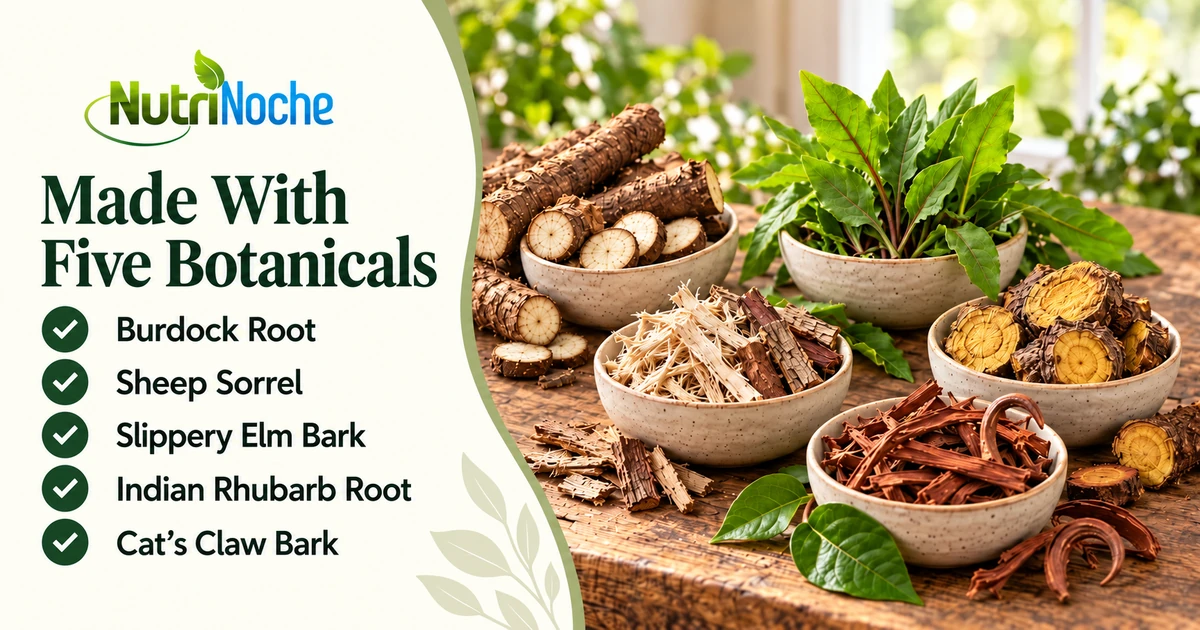
What Is Essiac Tea Made From?
The herbs and plant parts behind traditional and five-herb Essiac tea formulas.
Read Guide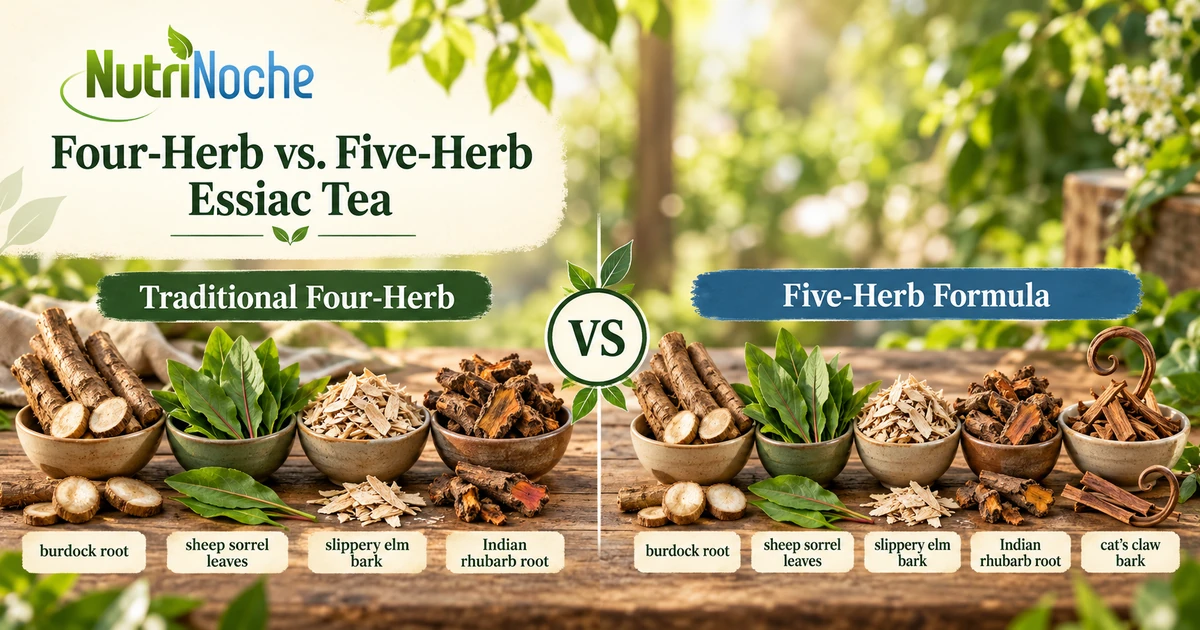
Four-Herb vs Five-Herb Essiac Tea: What Changes?
Compare the traditional four-herb formula with NutriNoche's five-herb blend.
Read Guide